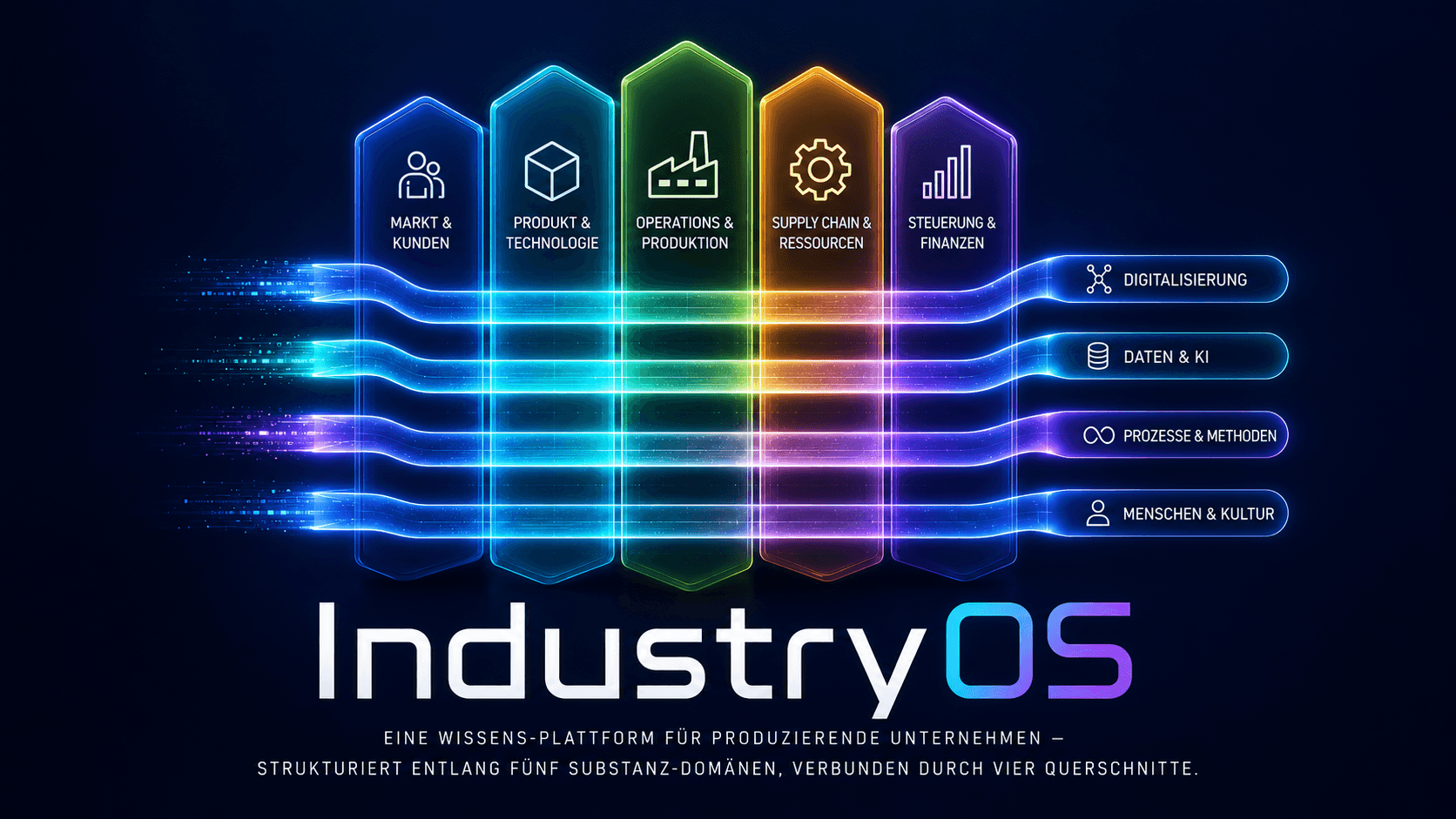
Five Views. Four Disciplines. No Mega-Project.
Competitive advantage comes from adaptive self-organization and quickly adaptable business models — not rigid IT and multi-year rollout programs. IndustryOS makes the ordering framework visible.
A knowledge platform for manufacturing — structured, connected, with open authorship. Build capabilities, don't buy systems.

Competitive advantage comes from adaptive self-organization and quickly adaptable business models — not rigid IT and multi-year rollout programs. IndustryOS makes the ordering framework visible.
IndustryOS explains digitalization for manufacturing — without chronology chaos, without anonymous authorship, without buzzwords.
Digitalization is more than technology — it's the way we store information, think, and act.
Every article has its home in one of the five domains. Tags and cross-cuts connect them across topics — visible in the knowledge graph.
Market understanding, customer requirements, voice of customer, product strategy.
From engineering to after-sales — the product lifecycle.
People, methods, structures — the ability to stay adaptable.
Data, systems, connectivity — the digital substance of the business.
Investment frame, KPIs, controlling — the compass in motion.
The knowledge graph shows 5 articles and 30 tags as a living network. Click along the relationships, find cross-connections and new entry points.
IndustryOS keeps three layers deliberately separate — like the building authority, the architect and the contractor on a site. The Kernel defines what things are. The Studio models by those rules. The Runtime operates the result. Three layers, one shared vocabulary.

Defines what things are.
The semantic and methodological foundation: a shared vocabulary for requirements, bills of materials and changes — plus the methodology used to assess them. It defines; it does not execute.

Models by the rules.
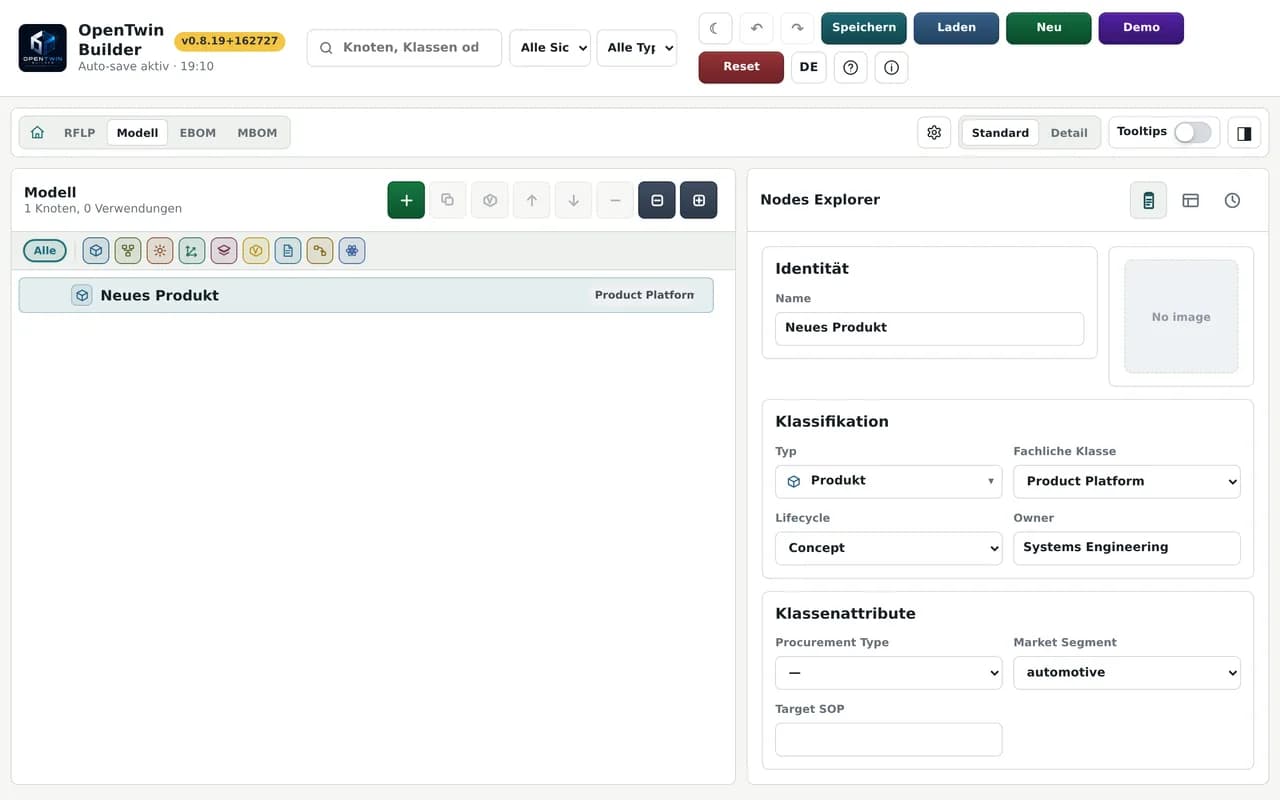
The authoring tool: create and maintain objects, bindings and contracts by the Kernel's rules — derive EBOM and MBOM, resolve variants, steer approvals.

Operates what was modeled.
The runtime platform: operates the knowledge graph and digital twins of the modeled objects, maintains authority and detects drift in live operation.
These principles apply equally to content and platform — and are the yardstick for every decision made here.
We pick the clearer path, even when the flashier one tempts us.
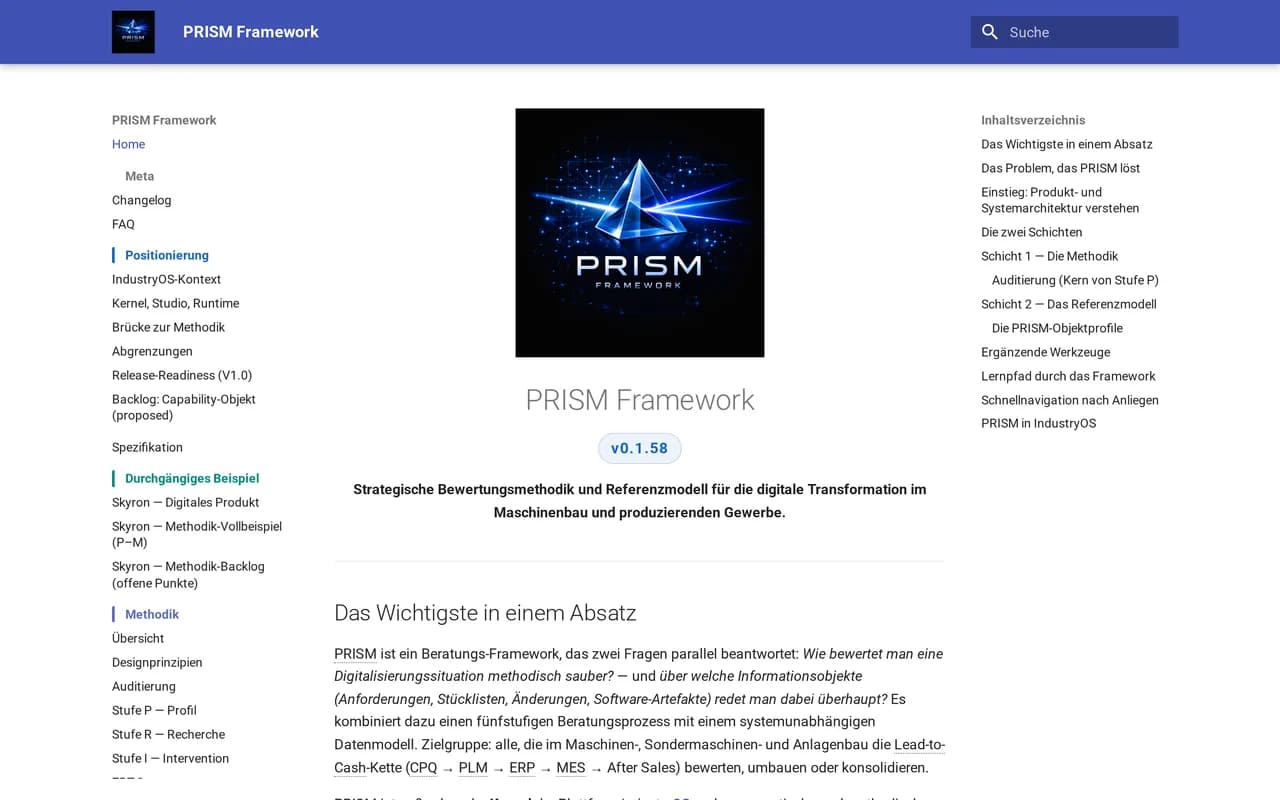
Our mission: depth without tech-voodoo.
Fast, clean, no bling. Every second of load time is an argument against us.
Continuous improvement, not big bang. Code and content grow with the work.
Best software design counts more than the feature itself.
Examples from real plants, not from textbooks.
We build with current tools. We explain old concepts — we don't adopt them.
We solve requirements with modern tools — open source wherever possible.
Every solution must deliver concrete benefit — otherwise it doesn't belong here.
A business user shouldn't need to know SAP tables. UI and language keep that separation strict.
Highly dynamic systems can't be planned through — only adaptable organizations and architectures survive. Instead of mega-transformation: continuous, local self-organization.
Think from the result backwards, not from the legacy. The question: what would be right if we started today?
Innovation happens where mistakes are named and discussed — not where they're hidden.
Modern technology solves problems — legacy debates don't. "Can't be done" isn't an option; change is the key to organizational and technological success.